Ordinal scope
The iteration scope depends on the scope type. For example, functions iterate within a class, tokens within a line, and characters within a token.
Without "every", plural ordinal forms produce one contiguous range. Prefix them with "every" to produce separate targets instead.
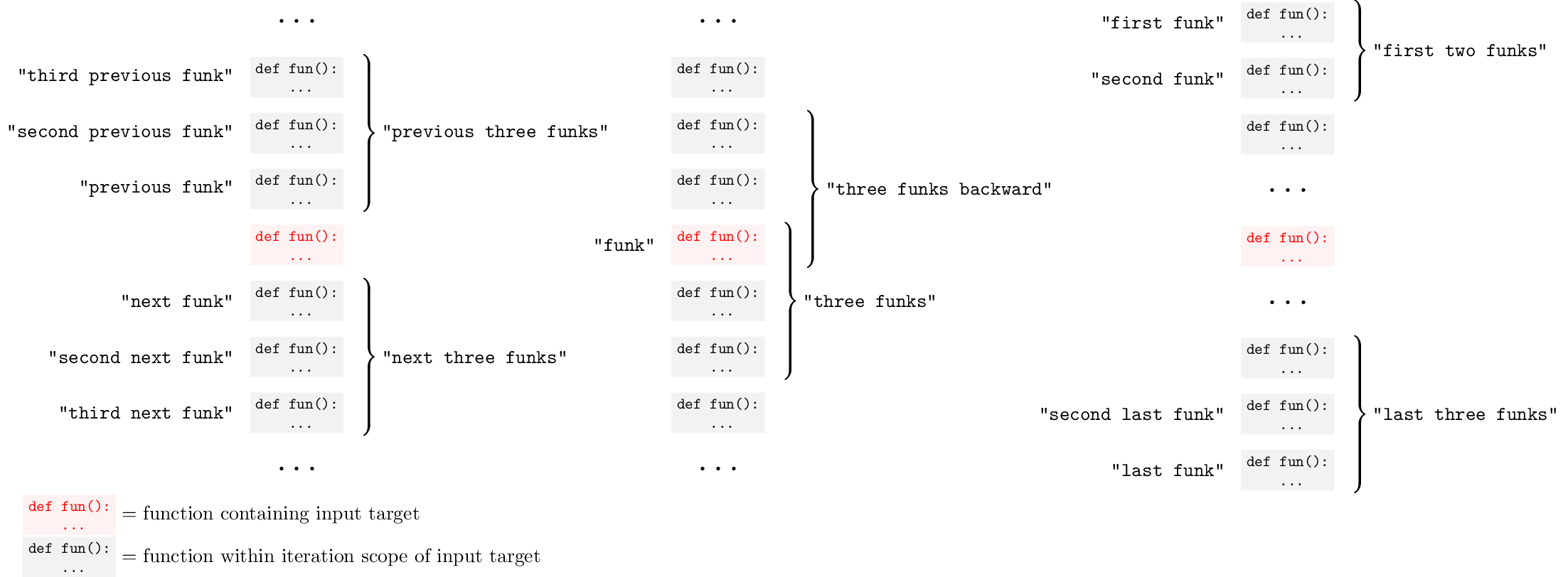
Cursorless ID: ordinalScope
Syntax
<ordinal><scope>-<ordinal>instance of<scope>in iteration scope.<ordinal>last<scope>-<ordinal>-to-last instance of<scope>in iteration scope.- first
<number><scope>s - First<number>instances of<scope>in iteration scope, as contiguous range. - every first
<number><scope>s - First<number>instances of<scope>in iteration scope, as individual targets. - last
<number><scope>s - Last<number>instances of<scope>in iteration scope, as contiguous range. - every last
<number><scope>s - Last<number>instances of<scope>in iteration scope, as individual targets.
Examples
"take third state"- Selects the third statement in the iteration scope."take third last state"- Selects the third-to-last statement in the iteration scope."take first three states"- Selects a contiguous range containing the first three statements in the iteration scope."take every first three states"- Selects the first three statements in the iteration scope as individual targets."take last three states"- Selects a contiguous range containing the last three statements in the iteration scope."take every last three states"- Selects the last three statements in the iteration scope as individual targets.
Visualization
"take first item"
Before
After
"take last item"
Before
After
"take first two items"
Before
After
"take last two items"
Before
After
"take first past second item"
Before
After
"take second past third item"
Before
After